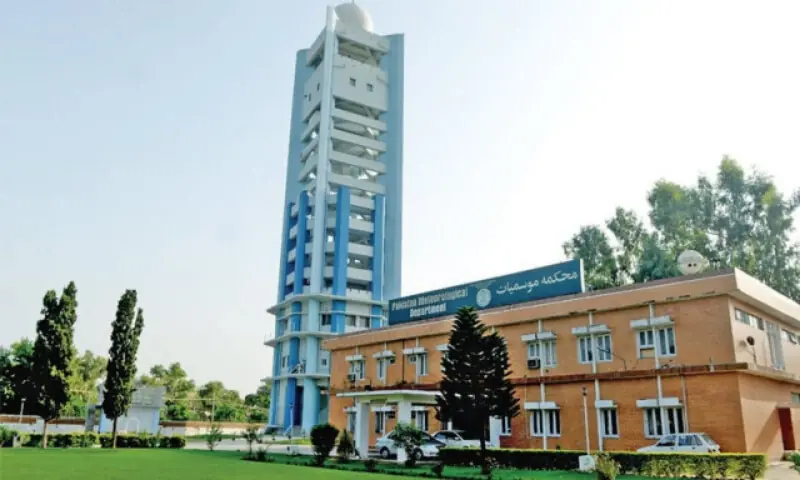
Pakistan’s Meteorological Department (PMD) is expanding its weather radar network across the country. A spokesman for PMD told Wealth Pakistan that they are adopting modern radar technology to monitor severe weather events, including floods, thunderstorms, heavy rainfall, and sea storms.
This initiative aims to enable forecasters to issue timely alerts and help protect lives and property, according to a press release. Currently, advanced radar systems operate in Islamabad, Karachi, Mardan, and Sialkot. A new radar is being installed in Multan with support from the Japan International Cooperation Agency (JICA).
Once completed, nearly all major regions of Pakistan will fall within radar coverage, significantly enhancing numerical weather prediction models and disaster preparedness capacity.
The 13-storey radar towers at PMD headquarters in Islamabad and Karachi have already been built with Japanese financial assistance. The S-band solid-state radars installed there can monitor weather activity within a radius of around 450 kilometres.
According to the spokesman, the radars provide real-time information on rainfall intensity, cloud formation, wind speed, wind direction, and storm movement. They update weather data every 10 minutes, allowing forecasters to closely track developing weather systems and issue alerts every few hours.
The PMD spokesman said Pakistan’s radar network includes S-band, C-band, and X-band systems, each selected according to topography and weather requirements. For example, the Islamabad and Karachi radars are S-band systems with coverage of up to 450 kilometres, while the X-band radar in Mardan covers around 120 kilometres and is used mainly for valley observations.
The C-band radar in Sialkot, which covers about 350 kilometres, plays a key role in tracking monsoon systems entering from Indian catchment areas. The Karachi radar is particularly important for monitoring sea-based weather activity and tropical storm systems over the Arabian Sea.
Earlier, the department had only five radar systems, many of which were outdated. The old Islamabad radar completed its 30-year operational life before being replaced with the latest Japanese-supported system.
Highlighting the importance of radar technology, the spokesman said rain gauges alone cannot provide widespread real-time weather information across vast regions, whereas modern radar systems can monitor weather activity over hundreds of kilometres instantly. Radar data is also shared with airports and aviation authorities, where PMD staff monitor weather conditions round the clock and brief pilots in real time about any hazardous activity along flight paths.
The Flood Forecasting Division in Lahore uses the radar network to monitor catchment areas and issue flood warnings, he added. The spokesman expressed confidence that with the completion of the Multan project and planned expansion to other cities, Pakistan’s weather forecasting capabilities would become far more accurate and effective in responding to climate-related threats.
The Aga Khan University's (AKU) Centre for Innovation in Medical Education (CIME), Karachi, hosted SIMPACT…
Meezan Bank, Pakistan's premier Islamic bank, once again partnered with The Indus Hospital & Health…
Pakistan’s leading digital microfinance bank, Mobilink Bank, and Yango, part of the global technology company…
Pakistan’s freelancing market is rapidly emerging, and the export earnings of Pakistani freelancers are expected…
To celebrate the release of Atif Aslam’s highly anticipated new album, Subah Aye Na, Spotify…
KARACHI: Supernet Technologies Limited (STL) is looking to strengthen its working-capital capacity as a growing…
This website uses cookies.
