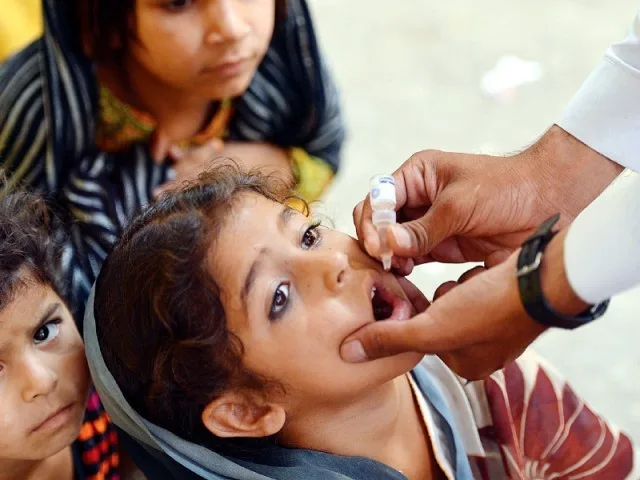
Punjab’s Struggle with Polio Endures Despite Recent Declines
The ongoing battle against poliovirus in Punjab underscores the complex challenges faced by public health officials in Pakistan. Although vaccination efforts have been largely successful, intermittent detection of the virus in sewage and environmental samples suggests that eradication remains elusive.
Annual increases in reported cases since 2015 highlight a persistent issue within the province. In 2024 alone, more than 60 cases were confirmed nationwide, with many originating from Punjab. Efforts by the government have included regular vaccination campaigns, which often fall short of achieving comprehensive eradication and do not always resonate with critics.
A recent surge in environmental surveillance data has underscored that poliovirus circulation continues to exist, despite periodic decreases in reported cases over the past decade. In Lahore, for instance, a four-fold rise in positive sewage tests between 2022 and 2023 signals persistent challenges ahead.
Salman Abid, a Public Policy Advisor, criticizes the PML-N government’s efforts as inadequate, pointing out that despite 14 years of governance, no significant grassroots measures have been implemented beyond sporadic vaccination campaigns. “The detection of poliovirus in environmental samples is a warning sign,” he argues. Yet, the Punjab Health Department spokesperson counters with progress: strong steps toward making Punjab completely polio-free are evident.
In recent years, only sporadic cases have emerged; by 2026, no significant cases were reported from Punjab. This achievement has been bolstered by falling environmental detection rates and improved coverage through immunization drives. The official adds that the current focus remains on reaching the remaining few percent of unvaccinated children.
However, Salman Abid emphasizes a broader approach is needed for comprehensive eradication. He stresses that this effort requires not only government intervention but also engagement at the grassroots level. This includes continued vaccination efforts and addressing sanitation and sewage issues through district administrations and community involvement.
The recent confirmation of the first wild polio case in 2026, specifically from Sindh province, adds another layer to this evolving health landscape, emphasizing that while some progress has been made, sustaining eradication requires sustained action at multiple levels.
The Aga Khan University's (AKU) Centre for Innovation in Medical Education (CIME), Karachi, hosted SIMPACT…
Meezan Bank, Pakistan's premier Islamic bank, once again partnered with The Indus Hospital & Health…
Pakistan’s leading digital microfinance bank, Mobilink Bank, and Yango, part of the global technology company…
Pakistan’s freelancing market is rapidly emerging, and the export earnings of Pakistani freelancers are expected…
To celebrate the release of Atif Aslam’s highly anticipated new album, Subah Aye Na, Spotify…
KARACHI: Supernet Technologies Limited (STL) is looking to strengthen its working-capital capacity as a growing…
This website uses cookies.
