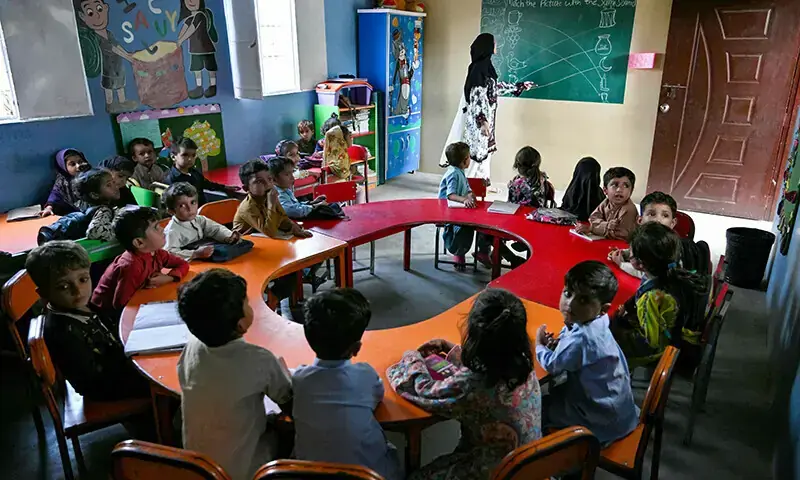
In Punjab, the government has implemented a new uniform dress code for all public sector school teachers aimed at promoting professionalism and respect. Teachers will now wear black gowns during school hours from February 23rd, as announced by the Punjab School Education Department on February 19th.
The directive came with instructions to chief executive officers (CEOs) of district education authorities (DEAs) to enforce the change province-wide. The department emphasized that teaching was a profession deserving of respect and moral leadership, which teachers could uphold through their conduct and appearance.
Under this policy, all teachers, regardless of gender or cadre, will be required to wear black gowns, with modest and decent attire underneath in accordance with cultural norms. For male teachers, the recommended style is shalwar kameez in plain colors; for female teachers, a suitable dress that reflects dignity is advised.
The heads of educational institutions are responsible for ensuring day-to-day compliance, while district-level CEOs will oversee strict implementation through monitoring mechanisms. The government categorizes this move as “most important” and instructs all parties to adhere strictly.
However, the initiative has sparked criticism from teachers’ representative bodies. The Punjab Teachers Union (PTU) General Secretary Rana Liaqat voiced his concerns during a press conference with Dawn. He highlighted that many schools in the province lack basic facilities such as sweepers for cleanliness, making it challenging to manage gowns effectively.
Liaqat pointed out that a gown typically costs between Rs3,000 and Rs4,000, noting that one teacher would need at least two gowns. He suggested alternative options: primary, middle, and high school teachers could wear shalwar kameez with waistcoats or dress pants with plain shirts instead of gowns. For higher education institutions, the government should consider integrating black gowns into the uniform for college and university faculty.
Liaqat also raised financial concerns; he claimed that many primary, middle, and high school teachers could not afford these additional costs. He proposed that if the policy was to be enforced, the government should provide monthly financial assistance or stipends for the attire. Additionally, he questioned who would be responsible in case the gowns were lost due to storage issues.
The move is seen as an attempt by the Punjab government to elevate teaching’s professional identity and promote a disciplined learning environment, yet it faces resistance from teachers’ bodies over practical and financial challenges.
AlphaX, a high performance on-chain cryptocurrency exchange committed to delivering a simplified, efficient and reliable…
Mobilink Bank is setting a new benchmark for sustainable banking in Pakistan, rapidly advancing its…
Meezan Bank is stepping up its digital payments strategy, expanding its merchant network and accelerating…
Islamabad, Pakistan: Pakistan’s march towards autism inclusivity needs to be powered through the education sector,…
Britain is set to convene a meeting involving approximately 35 nations this week. The purpose…
Prime Minister Shehbaz Sharif has ordered authorities to develop a comprehensive strategy to address the…
This website uses cookies.
