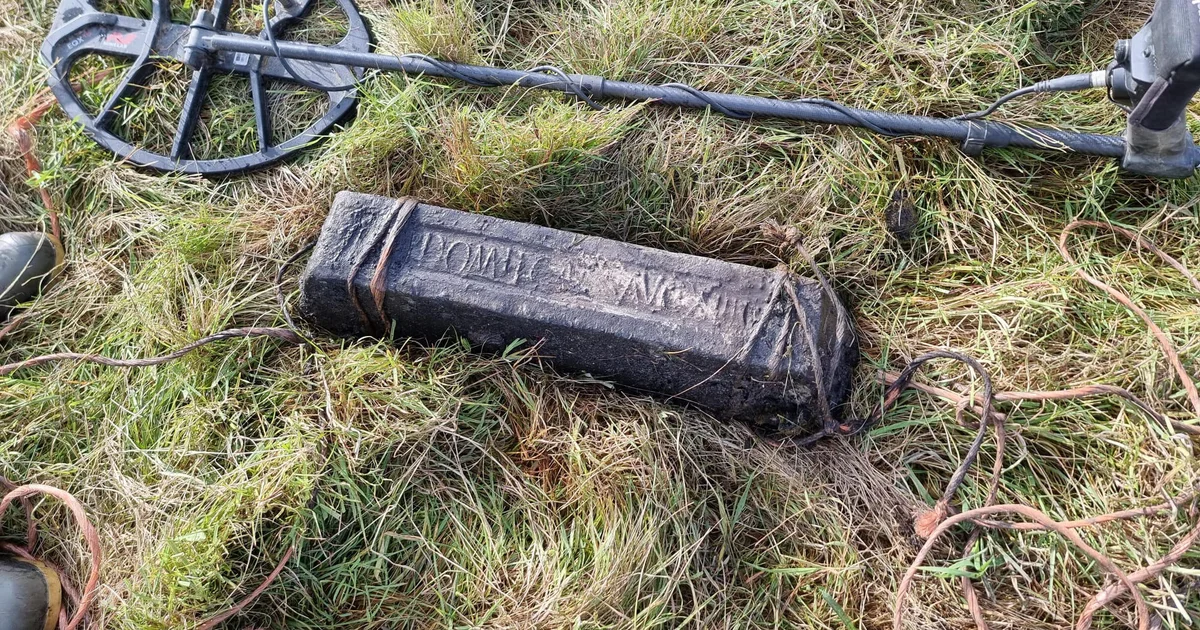
Two lead ingots dating back to Roman times have been unearthed in western Wales, marking an important discovery for local heritage. The finds, found by metal detectorists Nick Yallope and Peter Nicolas while searching on land owned by farmer Geraint Jenkins in Ceredigion, are the first of their kind discovered in the region.
The area’s rich mineral deposits were a significant reason why the Romans sought to conquer Ceredigion over two millennia ago. The museum curator, Carrie Canham, noted that lead mined here spread throughout the empire during this period.
Metal detectorists Nick Yallope and Peter Nicolas recently found these artifacts while searching land owned by farmer Geraint Jenkins in the coastal area of Ceredigion. The ingots are referred to as “lead pigs” and were used for tool-making and weaponry, with records indicating their origin dates back to AD 87 during the reign of Emperor Domitian.
In 2005, archaeologists discovered remains of a Roman lead smelting site in a peat bog nearby. The BBC reported that mines could have supplied these metals, which may have been distributed across the expansive Roman empire. The two ingots were found just under eighteen inches deep on farmland, with each piece approximately six feet apart.
“I am incredibly proud to have uncovered something so rare and crucial to our local heritage,” said Nick Yallope. “It’s fascinating to think that land we now farm organically was part of a much larger Roman landscape.”
Farmer Jenkins shared his perspective: “It’s remarkable to consider how the same fields you work today were integral parts of such an extensive Roman era.”
These lead ingots will be on display in a new archaeology gallery set to open at Amgueddfa Ceredigion Museum in spring 2027, according to Canham. Metal detectorists in Wales are required to obtain permission for private land exploration and report any suspected treasure items to the Portable Antiquities Scheme.
In parallel with these finds, between 2020 and 2022, a hoard of Bronze Age artifacts including axes, spearheads, rings, and a sword scabbard was unearthed by metal detectorists in Wales. The government declared these treasures in 2023.
The Aga Khan University's (AKU) Centre for Innovation in Medical Education (CIME), Karachi, hosted SIMPACT…
Meezan Bank, Pakistan's premier Islamic bank, once again partnered with The Indus Hospital & Health…
Pakistan’s leading digital microfinance bank, Mobilink Bank, and Yango, part of the global technology company…
Pakistan’s freelancing market is rapidly emerging, and the export earnings of Pakistani freelancers are expected…
To celebrate the release of Atif Aslam’s highly anticipated new album, Subah Aye Na, Spotify…
KARACHI: Supernet Technologies Limited (STL) is looking to strengthen its working-capital capacity as a growing…
This website uses cookies.
