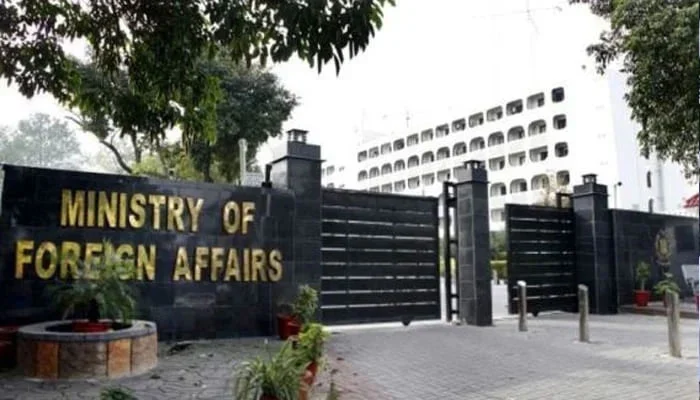
The Ministry of Foreign Affairs Pakistan building - APP/File
The Government of Pakistan organized an “Arria-formula” meeting of the UN Security Council on the topic “Upholding the Sanctity of Treaties for the Maintenance of International Peace and Security.” In addition to Security Council members, the meeting was attended by Member States from all regions. The meeting featured a distinguished panel of briefers: Mr. David Nanopoulos, Chief of the Treaties Section at the UN Office of Legal Affairs; Mr. Ahmer Bilal Soofi, President of the Research Society of International Law and former Federal Law Minister of Pakistan; Prince Zeid Ra’ad Al Hussein, President of the International Peace Institute and former United Nations High Commissioner for Human Rights; and Professor Adil Najam, Dean Emeritus and Professor of International Relations at Boston University.
The briefers underscored that treaties were binding legal instruments serving as stabilizing frameworks—particularly for managing shared natural resources, borders, and transboundary challenges. Drawing on historical and contemporary examples, including the unilateral suspension of the Indus Waters Treaty by India, the speakers warned that weakening international law risked collective security.
Speaking at the event, Ambassador Asim Iftikhar Ahmad, Pakistan’s Permanent Representative to the United Nations, emphasized that India’s unilateral suspension of the Indus Waters Treaty constituted a serious violation of international legal obligations. He noted that these violations had far-reaching humanitarian, environmental, and peace and security implications. Recalling an August 2025 decision by the Court of Arbitration for Investment Disputes (ICSID), Ambassador Ahmad highlighted that these rulings reaffirmed the treaty’s continued validity and the binding nature of its dispute-settlement mechanisms.
Ambassador Ahmad cautioned that undermining such treaties set a dangerous precedent for agreements governing shared resources, borders, and confidence-building arrangements globally. Member States participating in the discussion reaffirmed the centrality of treaties as instruments of stability and conflict prevention. They also highlighted the preventive role of the UN, including the Security Council, the Secretary-General, and the International Court of Justice (ICJ) in safeguarding treaty compliance and reinforcing international rule of law.
The meeting was widely welcomed as a timely and substantive contribution to international efforts to reinforce the rule of law in international relations and to prevent the erosion of treaty-based cooperation.
The Aga Khan University's (AKU) Centre for Innovation in Medical Education (CIME), Karachi, hosted SIMPACT…
Meezan Bank, Pakistan's premier Islamic bank, once again partnered with The Indus Hospital & Health…
Pakistan’s leading digital microfinance bank, Mobilink Bank, and Yango, part of the global technology company…
Pakistan’s freelancing market is rapidly emerging, and the export earnings of Pakistani freelancers are expected…
To celebrate the release of Atif Aslam’s highly anticipated new album, Subah Aye Na, Spotify…
KARACHI: Supernet Technologies Limited (STL) is looking to strengthen its working-capital capacity as a growing…
This website uses cookies.
