US Air Drops First Nuclear Microreactor: A Breakthrough for Deployment
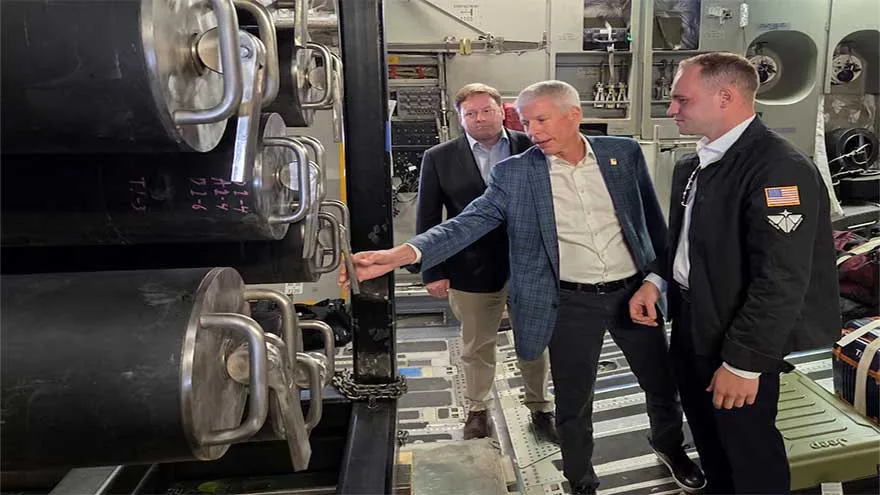
The United States took a significant step toward deploying small nuclear reactors on Sunday when the Departments of Energy and Defense transported a Ward microreactor from California to Utah aboard a C-17 aircraft. The move marked the first time such a device had been moved without its nuclear fuel.
In attendance at Hill Air Force Base in Utah were Energy Secretary Chris Wright and Undersecretary of Defense for Acquisition and Sustainment Michael Duffey, who hailed the event as a pivotal moment for both military and civilian energy needs. “This gets us closer to deploying nuclear power when and where it is needed to give our nation’s warfighters the tools they need to succeed,” said Duffey.
The microreactor in question measures approximately the size of a minivan and can generate up to 5 megawatts, enough to power around 5,000 homes. It was flown without nuclear fuel by partners Valar Atomics from California to Utah. The demonstration underscores President Donald Trump’s administration’s ambitions to boost domestic nuclear deployment as part of efforts to secure energy independence and support for technological advancements.
Small modular reactors like those under development have been touted as capable of being sent to far-flung areas, offering a viable alternative to traditional diesel generators that require frequent fuel deliveries. Yet, critics argue the viability of microreactors remains unproven, particularly concerning their cost competitiveness compared to other energy sources such as wind and solar.
Despite these reservations, supporters continue to advocate for small nuclear reactors due to their potential utility in remote settings where conventional power solutions are impractical or impossible. The Energy Department aims to have three microreactors reach a “critical” state — the point at which sustained nuclear reactions can be achieved — by July 4th. At full capacity this year, these units will provide up to 5 megawatts of electricity.
Valar CEO Isaiah Taylor announced plans to start selling power on a test basis in 2027 and become fully commercialized by 2028. The company relies primarily on private industry funding for its nuclear technology development but acknowledges the necessity of enabling federal policies, including fuel fabrication and uranium enrichment facilities, to support these efforts.
Wright also highlighted that while Valar aims to start selling power in a few years, the current microreactor being tested is still several critical steps away from full-scale commercial viability. The potential deployment scenarios underscore continued discussions with various states on proposed sites for nuclear waste reprocessing or permanent disposal.
As the United States advances its small modular reactor program, it continues to navigate an evolving landscape of public opinion and regulatory approval, balancing innovation against environmental concerns and practical utility.
The Aga Khan University's (AKU) Centre for Innovation in Medical Education (CIME), Karachi, hosted SIMPACT…
Meezan Bank, Pakistan's premier Islamic bank, once again partnered with The Indus Hospital & Health…
Pakistan’s leading digital microfinance bank, Mobilink Bank, and Yango, part of the global technology company…
Pakistan’s freelancing market is rapidly emerging, and the export earnings of Pakistani freelancers are expected…
To celebrate the release of Atif Aslam’s highly anticipated new album, Subah Aye Na, Spotify…
KARACHI: Supernet Technologies Limited (STL) is looking to strengthen its working-capital capacity as a growing…
This website uses cookies.
