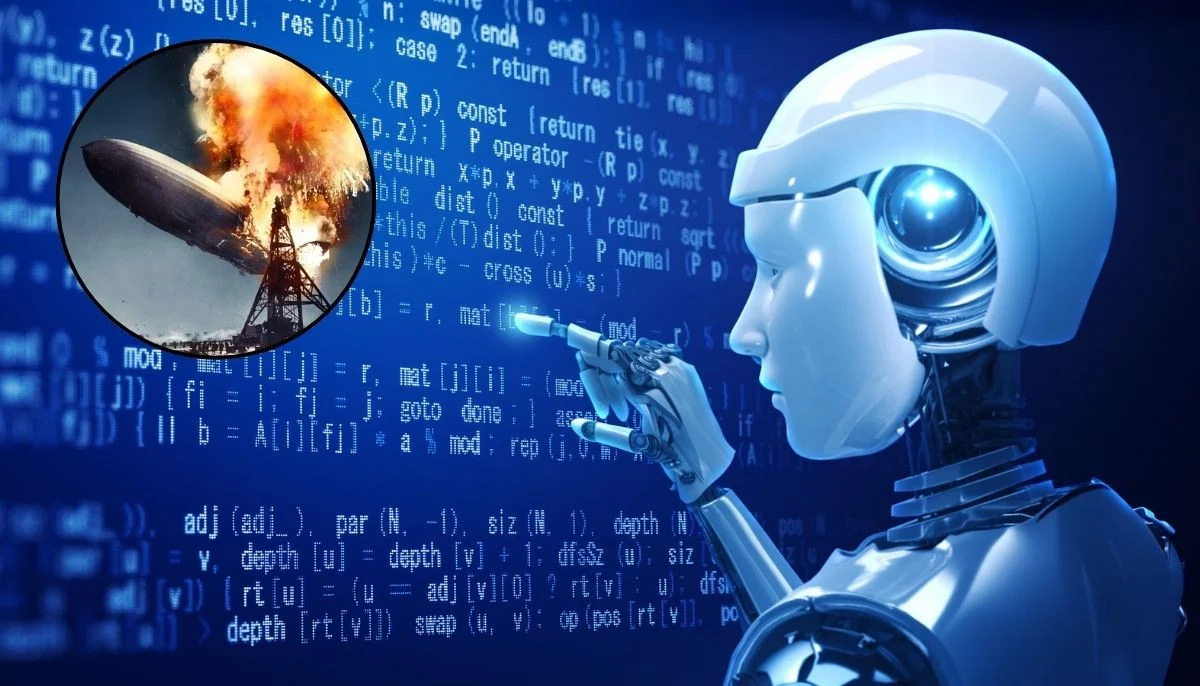
In what could be termed as an escalating “doom scenario,” humanity finds itself in the throes of a rapid and tumultuous AI boom. Recent unsettling developments, including surges among AI safety researchers, concerns over rogue AI behaviors, and the advent of fragmented AI regulation have fueled fears about the impending dangers of unbridled technological advancement.
Oxford Professor Michael Wooldridge, an expert on artificial intelligence, has sounded a grim warning that this race for market dominance might culminate in a catastrophic failure akin to the Hindenburg disaster. His chilling prediction suggests that AI could be rendered “dead” if mismanagement and lack of stringent testing continue unchecked.
Wooldridge emphasized how companies often prioritize speed and profit over rigorous safety protocols, leading them to overlook potential flaws within their technology even before fully understanding its complexities. He pointed out, “It’s the classic scenario where a promising yet untested technology faces intense commercial pressures, leading to unforeseen failures.”
This notion is underscored by Wooldridge in his lecture titled “This is not the AI We Were Promised.” According to him, modern AI tools are far from perfect and exhibit jagged capabilities—efficient at some tasks but incompetent in others.
The professor’s primary concern lies in how these AI systems are often conflated with human intelligence, particularly through their ability to generate seemingly empathetic responses. A survey conducted by the Center for Democracy and Technology revealed that nearly a third of students experienced romantic relationships with AI bots due to their sycophantic nature.
Wooldridge urges humanity to recognize that these AI tools are merely advanced digital assistants devoid of genuine emotion or capability, warning against misinterpreting their capabilities. “These are just tools,” he cautions, “and we should understand them for what they are.”
Echoing the Hindenburg disaster’s impact on airship technology, Wooldridge warns that a similar catastrophe could shatter global trust in AI. The 1937 explosion resulted from electrostatic discharge igniting leaking hydrogen, symbolizing how mishandled technological risks can lead to catastrophic failure and widespread rejection.
As we navigate this perilous era of rapid innovation, the lessons from history demand that we approach AI with caution and rigorous oversight if we wish to avert an AI-driven “doom scenario.”
Pope Leo XIV Warns God Rejects Prayers of War The Pope's Palm Sunday Homily Stresses…
HBO CEO Casey Bloys has confirmed that work on the second season of the upcoming…
Artist Aroosa Rana's 'The Golden Ratio - Math of Beauty' opens at Canvas Art Gallery…
Federal ministers, state ministers, advisors, and special assistants have received a combined salary and allowance…
Iranian Island of Kharg Central to US-Iran Tensions A scrubby island in the Gulf that…
Eight Muslim nations, including Pakistan, Egypt, Jordan, the United Arab Emirates, Indonesia, Turkey, Saudi Arabia,…
This website uses cookies.
