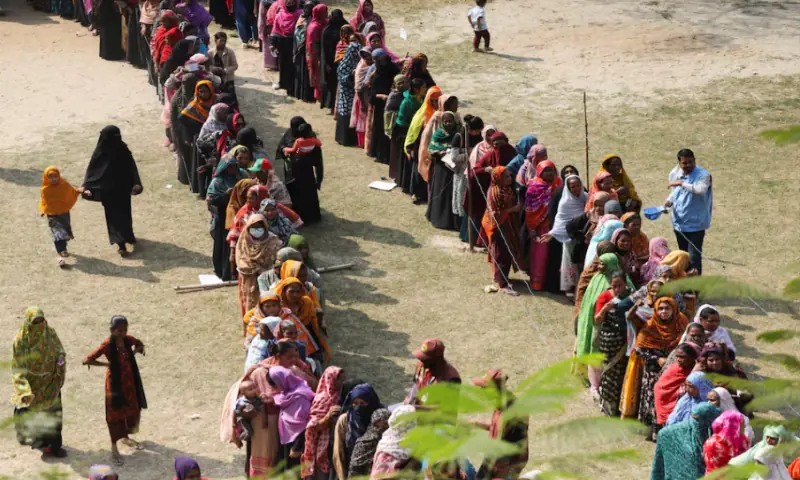
In Thursday’s early voting tallies, the Bangladesh Nationalist Party (BNP) edged past its Islamist rival, Jamaat-e-Islami, in a pivotal national election following months of anti-Prime Minister Sheikh Hasina unrest. The election marks the first since her government was ousted by a grassroots uprising involving millions of young Bangladeshi voters.
Analysts expect a decisive outcome vital for stabilizing Bangladesh amidst ongoing anti-Hasina violence and disruptions. This follows recent, widespread Gen Z-led uprisings across the wider region. Nepal will hold its own election next month.
Counting began at 4:30 p.m. (1030 GMT) post-poll closures, with final results forecast to be known by Friday morning, Election Commission officials stated. The race pits BNP and Jamaat, who polls had tipped slightly in favor of the former. As per local TV news channels, BNP was ahead in 50 seats, while Jamaat held only 18.
BNP’s leader Tarique Rahman declared victory on its official Facebook page for one seat he contested. However, final results remained pending as Election authorities yet to officially announce them.
Inside Dhaka’s party offices, ecstatic supporters cheered and clapped after Rahman was announced as a victor, showing footage of the event. Turnout appeared poised to surpass the 42% recorded in the last election. With more than 60% of registered voters expected to cast ballots, BNP’s future leadership seems set to be decided.
Hasina’s Awami League is currently banned and her leader remains in self-imposed exile in India, creating an opportunity for China to expand its influence in Bangladesh as relations with India deteriorate. Critics argue the recent election was marred by boycotts and intimidation.
In a statement via WhatsApp, Hasina denounced the vote as “a carefully planned farce” not recognized by her party or the electorate. She called for the cancellation of the election, removal of restrictions on Awami League activities, and free, fair, inclusive elections under a neutral caretaker government.
Elections also featured a referendum on constitutional reforms including establishing an interim neutral government, restructuring parliament into bicameral structure, increasing women’s representation, bolstering judicial independence, and a two-term limit for the prime minister. Over 2,000 candidates from numerous parties competed, with at least 50 participating.
Despite security precautions — over 2,000 police, army, and paramilitary personnel deployed nationwide — there were no reports of major violence. Outside polling stations in Dhaka, where BNP’s Rahman and interim government chief Muhammad Yunus cast their votes, policemen on horses reassured voters by displaying “Police are here, vote without fear.”
As Bangladeshi citizens prepared to make history at the polls, sentiments ran high with many expressing a sense of freedom they hadn’t felt in over 17 years. The election represents more than just political shifts; it’s an opportunity for renewed hope and unity after months of upheaval.
Taylor Frankie Paul will reportedly receive her full salary for her season of 'The Bachelorette',…
Pakistan's Ministry of Religious Affairs and Interfaith Harmony has finalized the flight schedule for Hajj…
El Paso and Los Angeles were among the most polluted areas in the United States…
Punjab Deports Over 33,000 Illegal Foreigners The process of expelling illegally residing foreign nationals has…
Sofia Richie Grainge and Elliot Grainge are now a family of four. The 27-year-old model…
A Los Angeles jury ruled that Alphabet's Google and Meta are liable for $3 million…
This website uses cookies.
