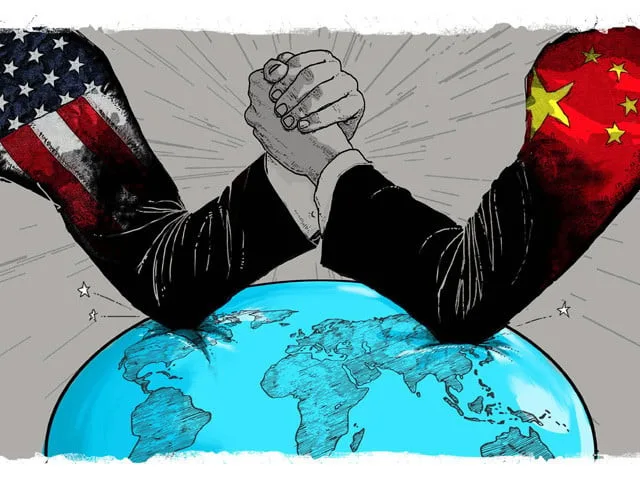
British Prime Minister Keir Starmer landed in Beijing on Wednesday, marking the first visit by a British premier to China in eight years. The trip reflects a significant shift in Western diplomacy amid strains in the US-led alliance system following President Donald Trump’s return to the White House.
Previously seen as a national security threat, Starmer is now seeking engagement with Chinese leader Xi Jinping—a move that underscores growing uncertainty among Washington’s traditional allies.
Other leaders have followed suit. In recent months, French, Irish, and Canadian heads of state have also traveled to Beijing, while German Chancellor Angela Merkel is expected to visit China next month. These diplomatic overtures were once unimaginable; just a few years ago, Western capitals largely aligned in confronting Beijing on issues such as trade, technology, and human rights.
The shifting dynamics coincide with a major economic realignment. Earlier this week, the 27-nation European Union and India signed a historic free trade agreement, widely dubbed the “mother of all deals.”
Negotiations on the EU-India free trade pact began in 2007 but collapsed in 2013 due to disagreements over tariffs, market access, intellectual property rights, and regulatory standards. For over a decade, the deal remained frozen, caught between mistrust and competing economic priorities.
The return of President Donald Trump changed everything. His aggressive economic nationalism, heavy reliance on tariffs, and transactional view of alliances pushed Brussels and New Delhi to revive talks and conclude the agreement, which covers nearly two billion people and about a quarter of global GDP.
For over a decade, Western allies were waiting for Washington to set the rules. Now, they are building parallel economic and strategic frameworks to safeguard their interests in an era where globalization is increasingly shaped by power politics rather than multilateral consensus.
Washington responded swiftly, with Commerce Secretary Gina Raimondo describing the agreement as “foolish” due to New Delhi’s continued import of Russian energy. This criticism reflects growing anxiety in Washington about its allies aligning economic choices independently of US strategic priorities.
The EU-India deal is a strategic hedge against American unpredictability. By reducing dependence on the US market, both sides hope to build economic resilience. For Trump, the agreement dilutes American leverage and could invite retaliation through tougher tariffs or political pressure.
Yet the bigger story extends beyond trade. Trump’s policies have accelerated a global realignment where many Western states are now engaging China, the very power long portrayed as the principal challenger to the rules-based international system.
Ideology is giving way to pragmatism. Trump’s policies have injected deep uncertainty into the global system. Allies that once relied on Washington for economic stability and security guarantees now fear becoming targets of the same “America First” agenda.
The EU-India deal, therefore, signals a broader transformation: The post-Cold War order built on US leadership, liberal trade, and multilateral institutions is giving way to a fragmented landscape of overlapping alliances and competing economic blocs. Trump did not create this shift but has undeniably accelerated it by weaponizing tariffs and redefining alliances as business contracts.
Western leaders are now engaging China, often without Washington’s approval. The US remains the dominant player in international affairs but is no longer automatically central to its allies’ strategies. As Western states seek their own paths with Beijing emerging as a key beneficiary, the global order has not collapsed—rather, it has been fundamentally reconfigured.
The Aga Khan University's (AKU) Centre for Innovation in Medical Education (CIME), Karachi, hosted SIMPACT…
Meezan Bank, Pakistan's premier Islamic bank, once again partnered with The Indus Hospital & Health…
Pakistan’s leading digital microfinance bank, Mobilink Bank, and Yango, part of the global technology company…
Pakistan’s freelancing market is rapidly emerging, and the export earnings of Pakistani freelancers are expected…
To celebrate the release of Atif Aslam’s highly anticipated new album, Subah Aye Na, Spotify…
KARACHI: Supernet Technologies Limited (STL) is looking to strengthen its working-capital capacity as a growing…
This website uses cookies.
