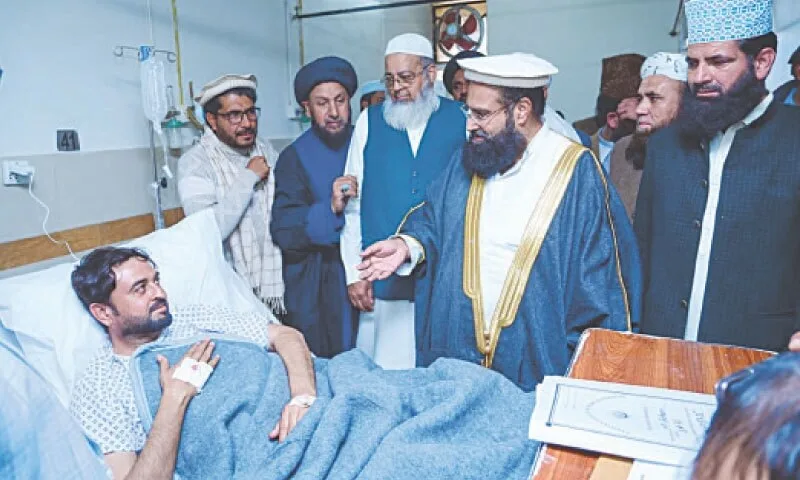
ISLAMABAD: For the first time in recent history, clerics representing all four mainstream schools of thought in Pakistan—Shia, Barelvi, Deobandi, and Ahle Hadith—visited both the victims and the site of a terrorist attack. The gathering took place at the Pakistan Institute of Medical Sciences (PIMS) where a suicide bomb blast had left 10 people dead during Friday prayers.
The National Paigam-i-Aman Committee, led by its coordinator Allama Hafiz Tahir Ashrafi, comprised these influential clerics and scholars. They were joined by community leaders from various madressah boards for the historic visit to Tarlai mosque, where a devastating attack had occurred just days prior.
Addressing an assembled news conference, Allama Tahir Ashrafi emphasized the need for patience and unity in times of crisis. “We are here today as clerics belonging to all mainstream schools in Pakistan,” he began, before going on to say, “This is not about numbers or politics; it’s about solidarity.”
The atmosphere at the gathering was visibly solemn, with scholars from different sects expressing their emotions upon meeting the victims and families of those affected. Ashrafi further highlighted that scholars from various denominations were united in purpose—despite differences in religious interpretations.
“We are one nation standing against a common enemy,” he stated emphatically. “Terrorists want to see us divided, but our unity is stronger than ever.”
Ashrafi called for an urgent and firm response by the entire country. “The enemies of Pakistan seek nothing less than its division,” Ashrafi warned. “This must not happen.”
He urged all segments of society to refrain from falling into divisions along ethnic or religious lines. Instead, he implored them to work together in promoting peace and stability.
In a statement to the media, Allama Hadiul Hussaini, who represents Gilgit-Baltistan, confirmed this as the first instance where clerics from all four major sects had united in such a manner. “Unity is key,” he emphasized. “Pakistan was built on unity; it cannot be torn apart by terror.”
Allama Sajjad Naqvi added his voice to the chorus of unity. “Our nation came together when we needed it most, and it will continue to stand united against any who seek to divide us.”
The gathering included a wide array of influential clerics: Allama Zahid Hussain, Allama Mushtaq Naqvi, Maulana Faheem Thanvi, Mufti Mir Ishfaq, Maulana Zahid Mansoor, Mufdi Qasim Qasmi, Maulana Saeed Chishti, Mufti Hafiz Iqbal, and Maulana Anis Ur Rehman.
This historic unity was seen as a powerful testament to Pakistan’s resilience in the face of terrorism. As the sun set over Tarlai mosque that day, clerics walked away from this meeting with renewed resolve to unite against any future acts of terror, reaffirming their commitment to Pakistan’s fabric and its people.
Violet Grohl, the daughter of Dave Grohl, prepares to release her debut album 'Be Sweet…
On April 6, Offset was hospitalized after being shot outside a casino in Florida. The…
Sindh Education Minister Syed Sardar Ali Shah met with a delegation from the Sindh Lecturers…
Ben Affleck reportedly handed over entire stake of Beverly Hills mansion to ex-wife Jennifer Lopez.…
Hundreds of Afghan refugees are returning to their homeland through the Chaman border daily. According…
Prince Harry and Meghan Markle reportedly facing tensions due to resurfaced flirty text messages between…
This website uses cookies.
