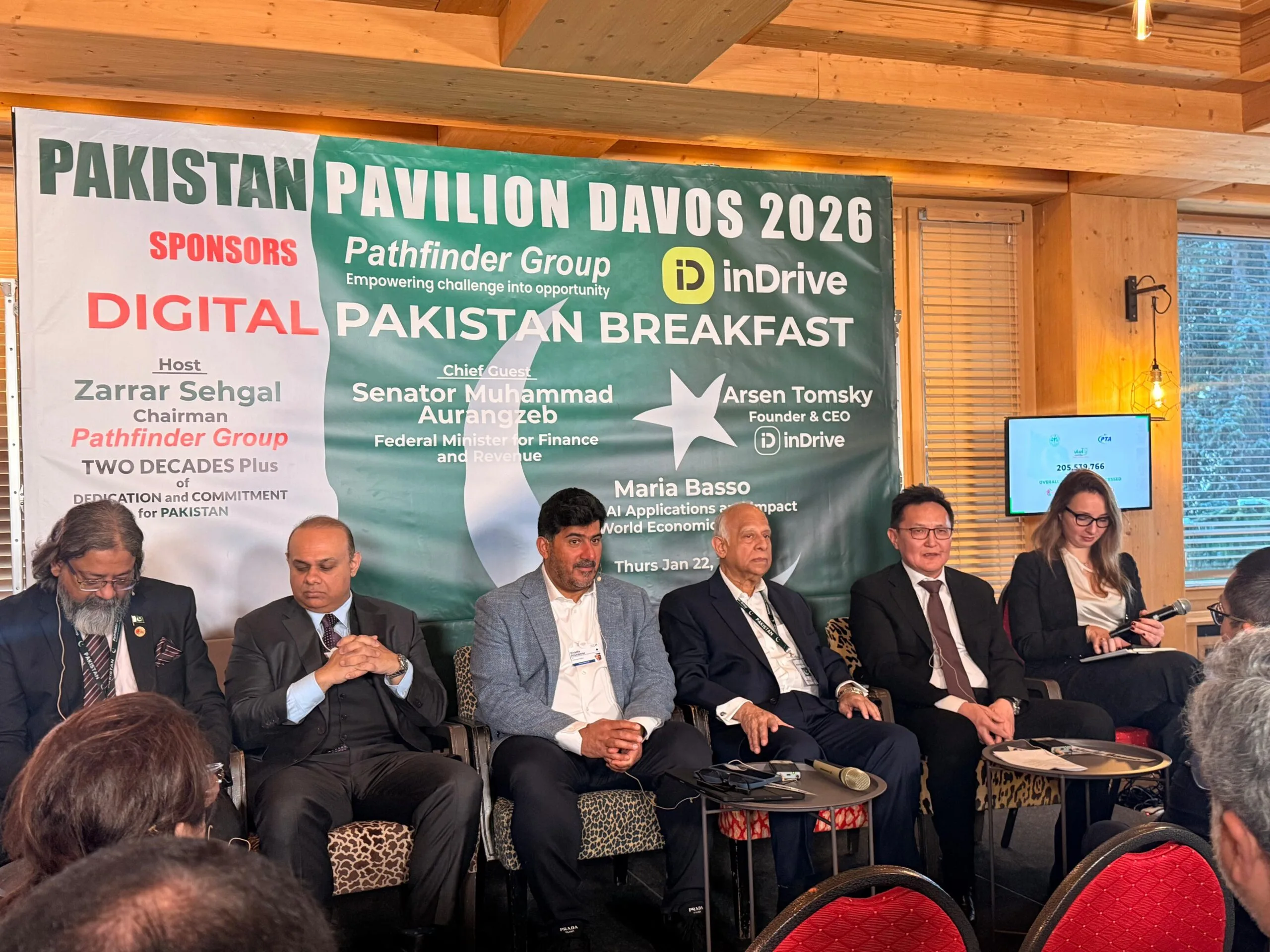
At the Digital Pakistan session at Davos, Arsen Tomsky, Founder and CEO of inDrive, discussed Pakistan’s digital economy, its growth potential, and the steps needed to support the country’s transition toward an inclusive digital economy through fair choice.
The session brought together a distinguished panel of speakers, including Maria Basso, Head of AI Applications & Impact at the World Economic Forum; Khalifa AlShamsi, CEO, e& life; Zarrar Sehgal, Chairman, Pathfinder Group; and Muhammad Salman Ali, CEO, VRG.
Tomsky positioned Pakistan as a priority market within inDrive’s global mission to challenge injustice. “I believe that three assets make Pakistan especially powerful: a young population, an entrepreneurial culture and its remarkable resilience,” he said. “We see ourselves as a long-term partner in Pakistan’s digital economy, enabling livelihoods, supporting communities, and building technology that makes everyday services more accessible and fair.”
Highlighting the country’s rapid yet uneven progress toward a digital economy, Tomsky noted that ride-hailing has become a critical layer in Pakistan’s broader digitisation journey. Since entering the market in 2021, inDrive has emerged as the number one-ranked ride-hailing application in Pakistan, now active in more than 20 cities for urban rides and over 200 cities for intercity travel, supporting mobility, productivity, and flexible earning opportunities at scale.
He further outlined inDrive’s expansion into a broader Super App ecosystem, spanning grocery delivery, freight, and fintech services. “People prosper when opportunity is widespread,” he said. “By offering multiple earning streams and keeping commissions low, we aim to make digital participation sustainable for drivers, students, and small businesses over time.”
During the discussion, Tomsky also highlighted findings from a recent Oxford Economics study covering seven emerging and frontier markets, including Pakistan. He noted that in price-sensitive markets with diverse income levels, fare negotiation serves as a powerful efficiency driver. “In Pakistan, a majority of riders and drivers surveyed reported completing more trips due to flexible pricing, which allows fares to remain affordable,” he said.
Concluding the session, Tomsky emphasised that fairness-driven design is essential for long-term digital adoption. “Platforms that give people transparency and agency are adopted faster and trusted longer,” he said. “I am humbled and inspired by the opportunity for inDrive to play its part in building a future that fully realizes the potential of Pakistan’s greatest asset: its people.”
This post was last modified on January 23, 2026 5:19 pm
The Aga Khan University's (AKU) Centre for Innovation in Medical Education (CIME), Karachi, hosted SIMPACT…
Meezan Bank, Pakistan's premier Islamic bank, once again partnered with The Indus Hospital & Health…
Pakistan’s leading digital microfinance bank, Mobilink Bank, and Yango, part of the global technology company…
Pakistan’s freelancing market is rapidly emerging, and the export earnings of Pakistani freelancers are expected…
To celebrate the release of Atif Aslam’s highly anticipated new album, Subah Aye Na, Spotify…
KARACHI: Supernet Technologies Limited (STL) is looking to strengthen its working-capital capacity as a growing…
This website uses cookies.
