Islamabad once thrived with lush greenery, a vision of wide avenues and tree-lined sectors that planners laid out decades ago. Yet today, the city is struggling against rapid urban development, leaving many residents deeply concerned and even embroiled in legal disputes over their cherished landscape.
In Muhammad Naveed’s case, he took the authorities to court this year for “large-scale tree cutting” on behalf of his community. He claims that thousands of mature trees were felled for infrastructure projects, leaving behind barren patches where once verdant spaces thrived. The World Wide Fund for Nature (WWF) has blamed major construction and military monuments for an alarming loss in Islamabad’s green cover. Between 2001 and 2024, the capital saw 14 hectares of tree cover disappear, equivalent to 20 football pitches—though this figure doesn’t account for any gains made during that period.
Kamran Abbasi, a local trader resident since the 1980s, feels profoundly. “Trees are life,” he says, lamenting how everywhere seems to be under construction now. “They cut trees everywhere.”
The loss of trees has repercussions beyond aesthetics; it affects air quality and urban health as well. Pollution is worsening in Islamabad, with poor air quality reaching unhealthy or very unhealthy levels, according to monitoring by IQAir. Polluted air can lead to respiratory issues like asthma, allergic reactions, and chest infections.
While some argue the cutting of trees for infrastructure projects helps mitigate seasonal pollen allergies exacerbated during spring, a solution lies not in indiscriminate removal but thoughtful urban planning. Experts recommend removing only those trees deemed necessary, replanting with non-allergenic species, and being more transparent about development projects.
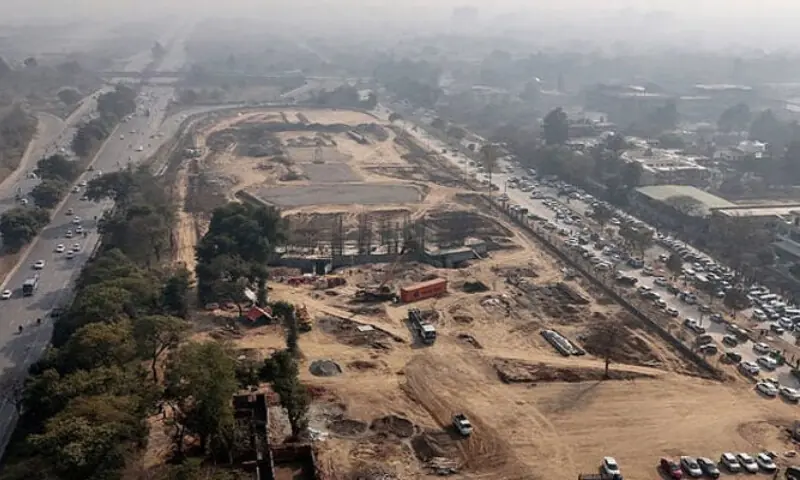
In recent months, large bulldozers have been spotted leveling former green belts near major highways. WWF reports that over six hectares of land were cleared for a military monument site along the express highway, despite it not having any existing park or public place designated for such memorials. Critics argue this is an excuse to justify broader tree-cutting linked to military and infrastructure projects.
The government plans to remove 29,000 pollen-producing trees, but some plots are being razed for military-related reasons. The military, long a powerful force in Pakistan’s governance, has ruled the country through coups and remains deeply involved in politics and economics.
At a monument site along Islamabad’s express highway, WWF documented six hectares of land cleared last year with ongoing work projected for 2026. The absence of any active planting indicated that this clearance was driven by infrastructure needs rather than conservation efforts.
In Naveed’s ongoing court case against the authorities’ tree-cutting practices, he argues there is “no excuse” for such losses. If a monument deemed essential were to be built elsewhere in public spaces like parks or town squares, why not? His petition seeks an end to this widespread destruction of green spaces and calls for greater accountability regarding development projects.
The fight over Islamabad’s remaining trees continues, with activists advocating for responsible urban planning that balances infrastructure needs with environmental conservation.
Pakistan Announces Expansion of Petroleum Storage Amid Saudi Investment Pakistan's decision to expand petroleum storage…
Savannah Guthrie returned to the Today show on April 6. She was issued a 'secret…
Iran's senior oil official says most damaged refining and distribution facilities will return to 70-80%…
Imtiaz Ali addressed rumors of sequels for his films Jab We Met and Tamasha. Released…
Hungarians began voting Sunday in an election that could end Prime Minister Viktor Orban's 16-year…
Legendary Indian playback singer Asha Bhosle passed away at age 92, confirmed by her family…
This website uses cookies.
