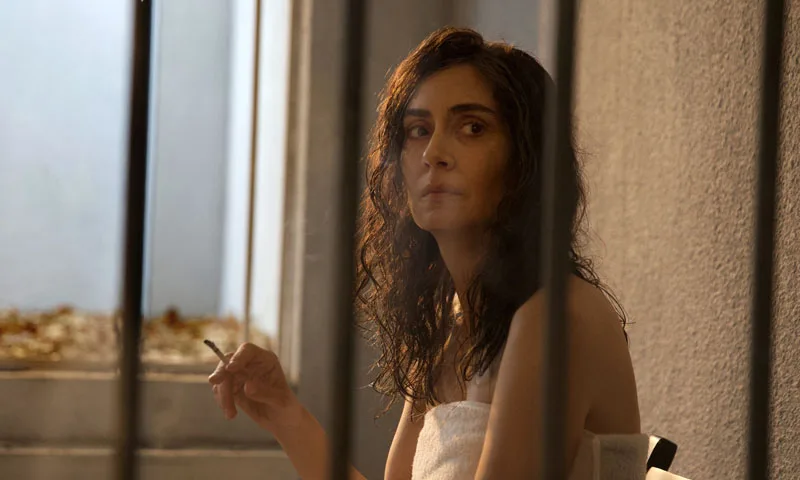
BERLIN: Iranian documentary filmmaker and women’s rights activist Mahnaz Mohammadi has turned to fiction to confront and portray the harrowing experiences she endured inside Tehran’s notorious Evin Prison, which also housed political prisoners. Her latest film, “Roya,” is set to premiere at the Berlin International Film Festival on Wednesday.
Speaking to Reuters in Berlin, Mohammadi explained that she had to navigate a delicate balance when crafting her personal story for the screen. “If I wanted my own story to be shown, it couldn’t have been portrayed as such—it was too painful and traumatic,” she said, noting how much she censored certain elements for public consumption.
Mohammadi has not been permitted to make films in Iran since 2019 after her feature film “Son-Mother” was released. For “Roya,” she shot the movie underground within Iran itself. The film opens with a first-person perspective inside Evin Prison, featuring flickering lights, screams from inmates, and cramped cells. As viewers move beyond this scene, the narrative shifts to character Roya, played by Turkish actress Melisa Sozen. This narrative intertwines past and present, reflecting psychological distress and dislocation.
Evin Prison has long been associated with detentions of political prisoners, intellectuals, and dual nationals. Human rights groups have repeatedly accused Iran of systematic torture within these walls, an accusation denied by Iranian authorities.
Mohammadi described returning to filmmaking as a painful yet necessary endeavor after her imprisonment. “To be in front of the camera is one of the most painful things,” she said. She declined to elaborate on her personal experiences but noted that Roya’s story represents broader shared experiences of repression within Iran, not directly testifying to her own ordeal.
The film’s premiere comes as Iran continues to face international scrutiny following a recent crackdown on nationwide protests—often described by human rights groups as the bloodiest since 1979. Despite ongoing challenges and uncertainty in Iran, Mohammadi remains hopeful about returning home after completing her current projects. “My home is Iran, but now I have no home,” she said. “I am like a nomad until I finish my project.”
The Aga Khan University's (AKU) Centre for Innovation in Medical Education (CIME), Karachi, hosted SIMPACT…
Meezan Bank, Pakistan's premier Islamic bank, once again partnered with The Indus Hospital & Health…
Pakistan’s leading digital microfinance bank, Mobilink Bank, and Yango, part of the global technology company…
Pakistan’s freelancing market is rapidly emerging, and the export earnings of Pakistani freelancers are expected…
To celebrate the release of Atif Aslam’s highly anticipated new album, Subah Aye Na, Spotify…
KARACHI: Supernet Technologies Limited (STL) is looking to strengthen its working-capital capacity as a growing…
This website uses cookies.
