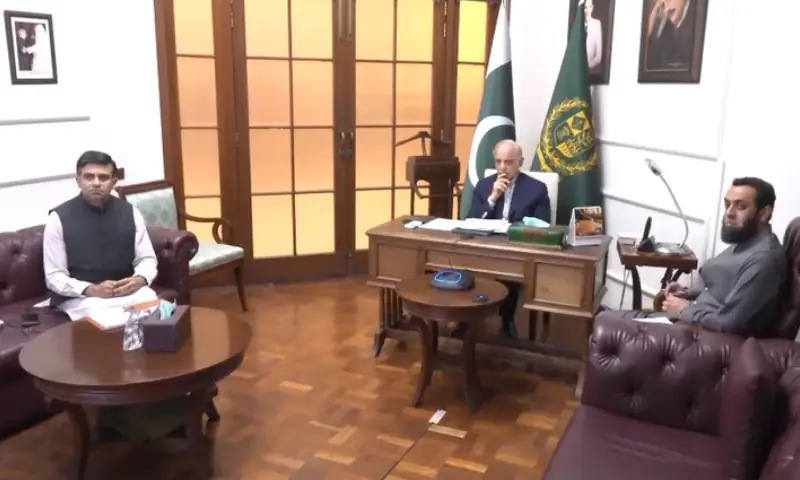
The Pakistan government has unveiled a series of austerity measures aimed at mitigating the economic impact of the US-Israel conflict with Iran. These decisions have come amid rising fuel costs triggered by global oil crises, which are affecting both domestic and international energy markets.
Under these reforms, employees within state-owned enterprises and autonomous institutions under government patronage will see their salaries cut by five to thirty percent. This move is intended to support public relief efforts. The decision was made during a meeting chaired by Prime Minister Shehbaz Sharif on Saturday, following his announcement of austerity measures the previous Monday.
Details from the Prime Minister’s Office reveal that this reduction in salary scales is part of wider initiatives meant to address the current economic climate, particularly influenced by geopolitical tensions and soaring fuel prices. The Finance Minister Muhammad Aurangzeb, alongside the Petroleum Minister Ali Pervaiz Malik, Information Minister Attaullah Tarar, and several other high-ranking officials, attended the meeting.
Notably, law enforcement agencies (LEAs) and Federal Board of Revenue personnel were exempted from this salary cut due to their essential roles. The decision also includes extending a four-day work week to all government entities except for LEAs and FBR operations, which will continue as usual.
A third-party audit is scheduled within the next two months to assess the government’s decisions to cut 60% of government vehicles and 50% of fuel allocations to all departments. In addition, a ban on all new vehicle purchases by government bodies has been announced. Furthermore, cabinet members, ministers, advisers, and special assistants’ salaries will be used solely for public welfare purposes.
The Prime Minister also directed that all Pakistani embassies globally observe March 23rd with minimal pomp and ceremony, adhering to the directives issued during his meetings. The decision was made in light of the current economic conditions and the government’s commitment to austerity measures aimed at bolstering public relief efforts.
In summary, these measures represent a significant shift towards cost-cutting within the federal government framework, reflecting both immediate challenges and long-term planning for sustainable financial management amidst global oil price volatility.
Former Sindh Chief Minister Syed Qaim Ali Shah met with PPP Chairman Bilawal Bhutto Zardari…
Prime Minister Shehbaz Sharif joins global community in commemorating World Health Day on April 7.…
Apple's rumored foldable iPhone, known as the iPhone Fold, has entered trial production with Foxconn,…
Meghan Markle is advised against using the Royal Family for promotional purposes. The Duchess of…
Six Pakistan Tehreek-e-Insaf (PTI) lawyers have been named in a list handed over to Adiala…
Lady Gaga cancels Montreal show due to respiratory infection Popstar Lady Gaga canceled her Mayhem…
This website uses cookies.
