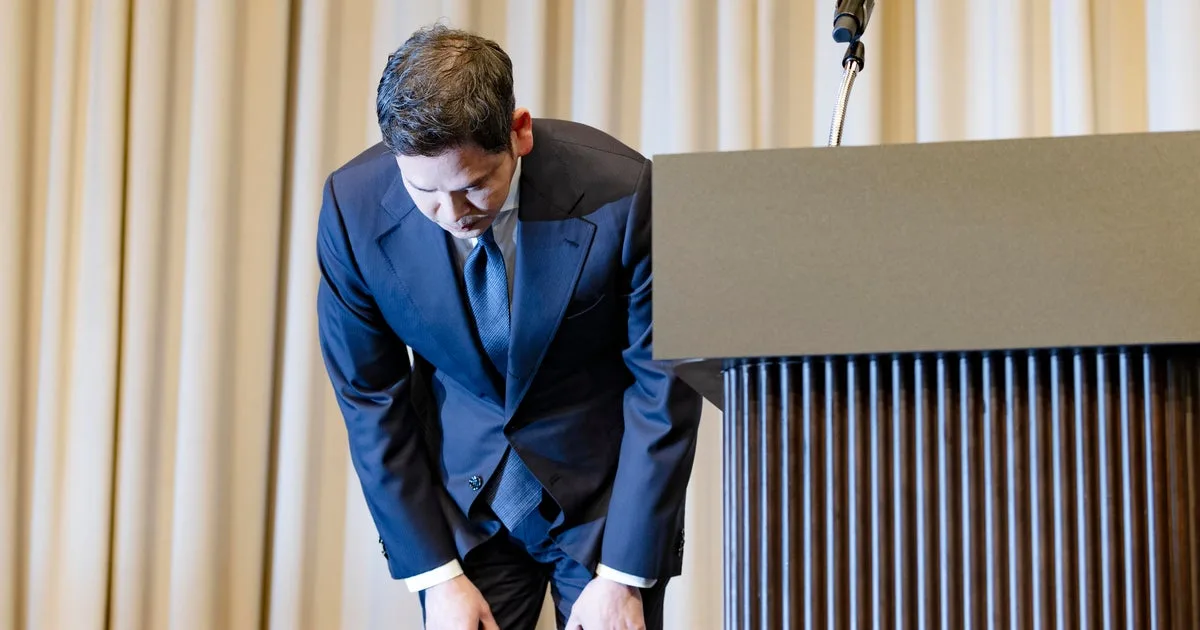
Seoul — On Tuesday, South Korean retail tycoon Chung Yong-jin issued his second apology within two weeks amid backlash against Starbucks’ local operation over a recent marketing campaign perceived as mocking victims of a 1980 military crackdown on pro-democracy protesters in Gwangju.
Chung, chairman of Shinsegae Group owning a 67.5% stake in Starbucks Korea, bowed three times during a televised statement and pleaded for forgiveness from the families of democracy activists killed by South Korea’s former military dictatorship and the broader public.
The coffee chain sparked outrage when it promoted a large size of its tumbler called “tank” on May 18, the anniversary of a democratic uprising in Gwangju that was brutally suppressed, killing or injuring hundreds. The campaign used the slogan “Thwack it on the table!” which many interpreted as referencing a police statement attempting to cover up the torture death of student activist Park Jong-chol.
The promotion was immediately met with outrage and Shinsegae canceled it and fired Starbucks Korea’s CEO. Police also opened an investigation based on complaints from families of people killed in Gwangju.
Chung said Tuesday that he took seriously the fact many felt deep pain and anger due to Starbucks Korea’s inappropriate marketing campaign, asking people not to take out their frustration on staff at Starbucks shops.
Shinsegae Group executive Jeon Sangjin said the company has yet to find conclusive evidence Starbucks Korea employees intended to mock the pro-democracy movement, an accusation the employees have denied. However, some refused management requests to hand over their smartphones during a weeklong internal review.
The anger over the campaign has triggered public calls for boycotts, amplified by government officials who said Starbucks products will no longer be used at government events and lamented the chain’s “anti-historical behavior.”
A Shinsegae official told Reuters news agency that sales had fallen dramatically in the wake of the marketing controversy. President Lee Jae Myung criticized the campaign on X as displaying “inhumane and disgraceful behavior by cheap profiteers who deny the values of the South Korean community, basic human rights and democracy.”
The crackdown in Gwangju came months after General Chun Doo-hwan seized power in a 1979 coup. Government records show about 200 people died in Gwangju, but activists say the true death toll was much higher. Chun’s government also imprisoned tens of thousands, saying it was rooting out social evils.
Public anger over Chun’s dictatorship led to massive nationwide protests in 1987, forcing him to accept a constitutional revision introducing direct presidential elections that is widely seen as the start of South Korea’s transition to democracy.
The Aga Khan University's (AKU) Centre for Innovation in Medical Education (CIME), Karachi, hosted SIMPACT…
Meezan Bank, Pakistan's premier Islamic bank, once again partnered with The Indus Hospital & Health…
Pakistan’s leading digital microfinance bank, Mobilink Bank, and Yango, part of the global technology company…
Pakistan’s freelancing market is rapidly emerging, and the export earnings of Pakistani freelancers are expected…
To celebrate the release of Atif Aslam’s highly anticipated new album, Subah Aye Na, Spotify…
KARACHI: Supernet Technologies Limited (STL) is looking to strengthen its working-capital capacity as a growing…
This website uses cookies.
