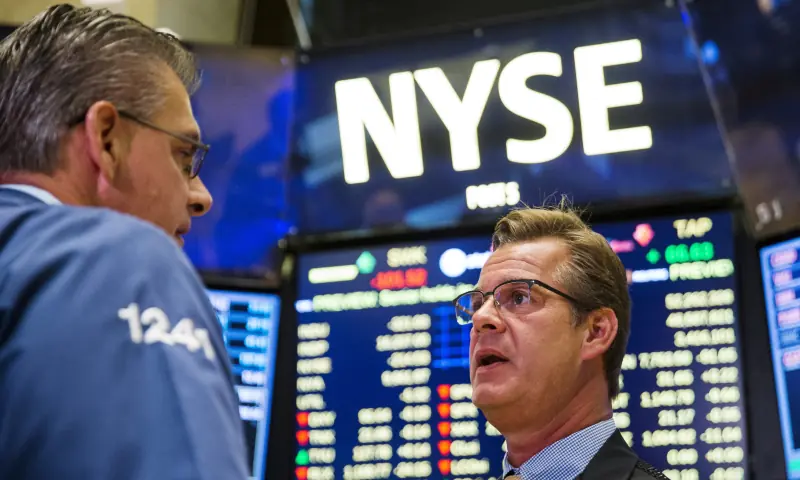
Wall Street closed sharply lower on Friday, marking its lowest point in six months as tensions escalated between the US and Iran. The S&P 500 fell to its lowest level since September amid concerns over inflation and potential interest rate hikes.
The conflict intensified with the deployment of an amphibious assault ship carrying thousands more Marines and sailors to the Middle East. Meanwhile, Iran’s new supreme leader emphasized “unity” and “resistance.”
Market experts attribute the decline to growing fears that the conflict could extend beyond a few weeks, potentially several months. Jake Dollarhide from Longbow Asset Management noted, “The market is finally settling into the idea that this may go on longer than initially expected.”
Key tech companies like Nvidia and Tesla suffered significant losses, dropping over 3%. Major players such as Alphabet, Meta Platforms, and Microsoft all fell by about 2%.
US Treasuries also declined for a third session, aligning with broader declines in UK and European government bonds. The Middle East conflict has kept oil prices high, fueling inflation concerns.
US rate futures indicate that the Federal Reserve is more likely to raise interest rates than cut them by the end of 2026, according to CME’s FedWatch tool.
Padhraic Garvey from ING highlighted that higher inflation expectations and ongoing geopolitical stress are pushing rates up. The S&P 500 declined 1.51% to 6,506.48 points, its lowest since September.
The Nasdaq fell 2.01% to 21,647.61 points, down nearly 10% from its record high on October 29. The Dow Jones Industrial Average dropped 0.96% to 45,577.47 points.
Nine of the eleven S&P 500 sector indexes declined, with utilities losing 4.11%, followed by a 3.15% drop in real estate. Despite this, the energy sector index was flat but recorded its 13th weekly gain since at least the late 1980s due to geopolitical events dominating much of the first quarter.
Friday marked the simultaneous expiry of derivatives contracts tied to stocks, index options, and futures, known as “triple witching,” with heavy trading volumes. For the week, the S&P 500 lost 1.9%, while the Nasdaq and Dow declined by over 2%.
Since the conflict began on February 28, the S&P 500 has fallen 5.4%, the Nasdaq 4.5%, and the Dow is down nearly 7%. All three major indexes are now below their 200-day moving averages, reflecting deteriorating sentiment.
FedEx’s shares rose almost 1% after issuing forecasts of steady global demand despite geopolitical tensions. Despite this, declining stocks outnumbered rising ones within the S&P 500 by a ratio of 3.4-to-1. The S&P 500 recorded 11 new highs and 36 new lows; the Nasdaq saw 43 new highs and 274 new lows.
The Aga Khan University's (AKU) Centre for Innovation in Medical Education (CIME), Karachi, hosted SIMPACT…
Meezan Bank, Pakistan's premier Islamic bank, once again partnered with The Indus Hospital & Health…
Pakistan’s leading digital microfinance bank, Mobilink Bank, and Yango, part of the global technology company…
Pakistan’s freelancing market is rapidly emerging, and the export earnings of Pakistani freelancers are expected…
To celebrate the release of Atif Aslam’s highly anticipated new album, Subah Aye Na, Spotify…
KARACHI: Supernet Technologies Limited (STL) is looking to strengthen its working-capital capacity as a growing…
This website uses cookies.
