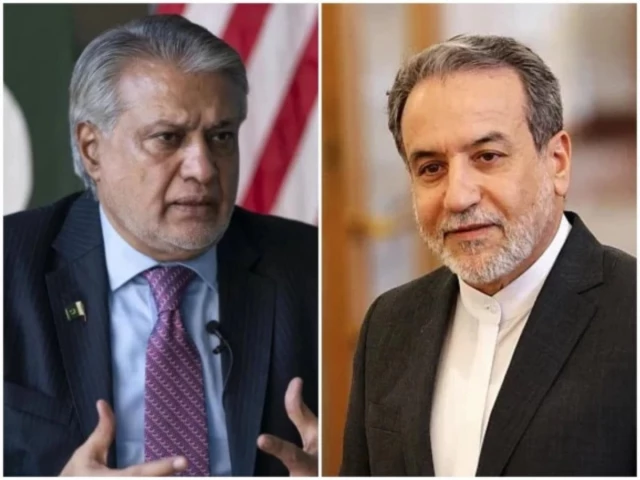
Deputy Prime Minister and Foreign Minister Ishaq Dar stressed the importance of sustaining the ceasefire between Washington and Tehran during a telephone conversation with his Iranian counterpart Abbas Araghchi on Monday.
The Islamic Republic’s negotiating team had stopped exchanging messages with Washington through mediators over attacks on Lebanon, where the US-Israeli war against Iran has reignited Israel’s conflict with Hezbollah. However, President Donald Trump later claimed that talks were ongoing at a rapid pace and Israel had agreed to send no troops to Beirut.
The two leaders discussed the current regional situation and developments of mutual interest and agreed to remain in close contact. Dar conveyed Pakistan’s serious concern over ensuring that the ceasefire is sustained to prevent any breakdown of existing understandings, while Araghchi expressed concern over recent developments in the region, including alleged ceasefire violations by Israel in Lebanon.
Iran’s Mehr News Agency reported that FM Araghchi also held a telephone conversation with Chief of Defence Forces and Chief of the Army Staff Field Marshal Asim Munir. Dar spoke with Egypt’s Foreign Minister Badr Abdelatty, emphasizing the need for sustained diplomatic engagement to promote peace and stability.
Pakistan emerged as a central facilitator in the sensitive diplomatic track, positioning itself as an “honest broker” amid sharply polarized positions between Washington and Tehran.
The war began in February 2026 when US and Israeli strikes targeted Iranian military infrastructure. Iran retaliated across the region and closed the Strait of Hormuz, triggering a global energy shock. By early April, Trump was threatening to destroy Iranian civilization entirely, with deadlines set for March 21, then March 23, then April 7, as diplomats scrambled for an opening.
Pakistan provided that opening on April 8 when it brokered a conditional two-week ceasefire. Trump confirmed it himself, naming Field Marshal Asim Munir and Prime Minister Shehbaz Sharif as the Pakistanis who had persuaded him to stand down. Iranian Foreign Minister Abbas Araghchi was equally warm, publicly thanking Pakistan’s tireless efforts on behalf of the Islamic Republic.
With a ceasefire in place, Pakistan moved swiftly to host formal negotiations. On April 11 and 12, delegations from the United States and Iran convened at the Islamabad Serena Hotel. The talks ran for 21 hours and while both sides reported progress on most points, two issues proved intractable: the Strait of Hormuz and Iran’s nuclear programme. No agreement was reached. No memorandum was signed.
The Aga Khan University's (AKU) Centre for Innovation in Medical Education (CIME), Karachi, hosted SIMPACT…
Meezan Bank, Pakistan's premier Islamic bank, once again partnered with The Indus Hospital & Health…
Pakistan’s leading digital microfinance bank, Mobilink Bank, and Yango, part of the global technology company…
Pakistan’s freelancing market is rapidly emerging, and the export earnings of Pakistani freelancers are expected…
To celebrate the release of Atif Aslam’s highly anticipated new album, Subah Aye Na, Spotify…
KARACHI: Supernet Technologies Limited (STL) is looking to strengthen its working-capital capacity as a growing…
This website uses cookies.
