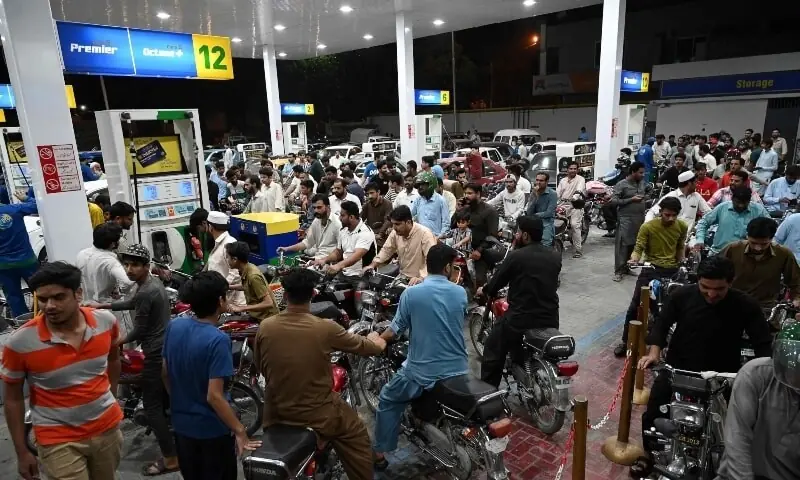
ISLAMABAD: A significant price hike is looming for all petroleum products across Pakistan, setting in motion a cascade of economic implications as the next fortnight approaches.
On Saturday, official sources announced an estimated increase of Rs4.50 to Rs7 per litre for petrol and related products including high-speed diesel (HSD), kerosene, and light diesel oil (LDO) over the subsequent two weeks ending March 15. This move follows a slight upward trend in international crude prices attributed to regional tensions.
Currently, ex-depot prices for various products are as follows: petrol is priced at Rs258.17 per litre with retail prices typically running about Rs259.30 higher; HSD stands at Rs275.70, while LDO and kerosene currently cost around Rs161.72 and Rs180.53 per litre respectively. These rates are already significantly below the open market price for kerosene, which generally trades above Rs300 per litre.
While taxes account for about Rs105 per litre on petrol and Rs98 on HSD based on existing tax rates, these levies contribute to a total levy of around Rs120–Rs170 per litre. Petrol is predominantly used in private transport and small vehicles, thereby impacting the budgets of middle and lower-middle classes. The price elasticity of HSD affects heavy industries such as railways and agriculture, where its use contributes substantially to agricultural processes like farming equipment and irrigation systems.
The government also levies about Rs17-18 per litre on both petrol and HSD for customs duty, irrespective of local production or imports, while an additional Rs17 per litre covers distribution and sale margins in the hands of oil companies. Notably, petroleum products including petrol and HSD generate over 90% of the government’s revenue, with average monthly sales of approximately 700,000–800,000 tonnes for these commodities versus just 10,000 tonnes for kerosene.
In FY2025, Pakistan collected about Rs1.161 trillion from petroleum levies alone, and the government expects this figure to surge by around 27% to approximately Rs1.470 trillion in the current fiscal year.
This move could intensify financial strains on consumers and businesses alike, prompting a closer look at how regional tensions and global crude markets are reshaping Pakistan’s energy landscape.
Brooklyn Beckham marked four years of marriage with Nicola Peltz with a romantic gesture at…
Dax Shepard was visibly moved to tears as he recalled how his wife, Kristen Bell,…
Gold prices surged in both local and global markets on Friday. The per tola rate…
Lahore High Court to Hear Petition on April 13 The Lahore High Court has scheduled…
Showrunner Eric Kripke Reveals His Hesitation Over A-Train's Death Eric Kripke, the showrunner for The…
IMF Managing Director Kristalina Georgieva Warns Iran Conflict Will Scar Global Economy The head of…
This website uses cookies.
